Apple Search Ads LAT Tracking and Its Impact on ASA Attribution
What is Apple Search Ads LAT Tracking and Its Impact on ASA Attribution?
Share this article



 ASA Blogs
 Apple Search Ads has been a powerful acquisition tool for app marketing for many years. It's a tried-and-true method for connecting advertisers with a relevant target audience to increase conversions. App developers can significantly improve their visibility in the App Store by using Apple Search Ads, giving them a competitive advantage. And, with two different solutions available—basic and advanced—advertisers can implement simple or complex campaigns, depending on the goals of their organization.
While Apple Search Ads provides a channel for advertisers to convert more users, users are well aware that companies are gathering as much information as possible to track them. As a result, privacy settings in Apple's mobile ecosystem are becoming increasingly stringent. Limit Ad Tracking (LAT), a simple but sophisticated feature that can be enabled on mobile devices to prevent data collection by apps and to help maintain privacy rights, is becoming increasingly popular. Limit Ad Tracking shook up the advertising industry by giving users the option to protect their personal information.
Users are turning on Limit Ad Tracking (LAT) to feel safer, as iPhone devices now account for approximately 45% of the US smartphone market. This means that advertisers will face new challenges when they launch their App Store search ads to reach iOS users.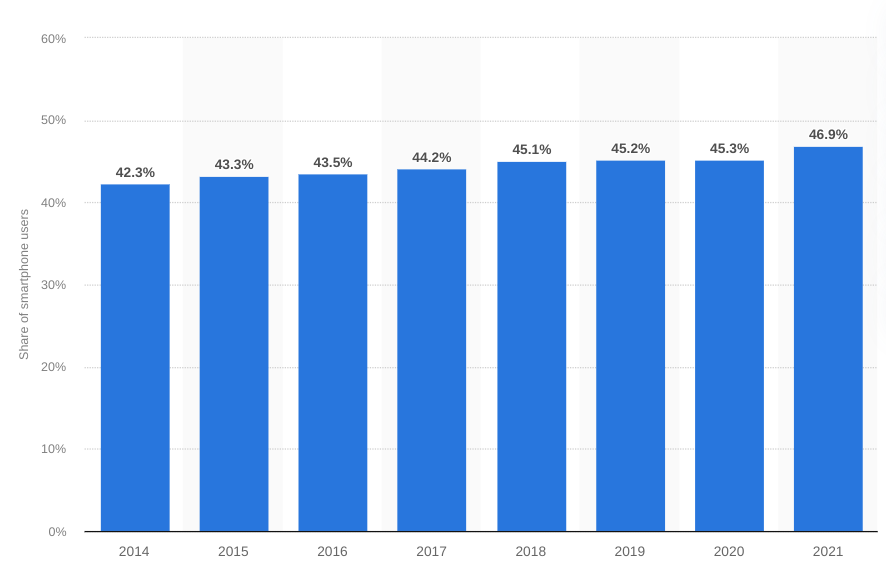
What Is Limit Ad Tracking (LAT)?
Limit Ad Tracking (LAT) is a feature on Apple's mobile operating system that allows users to opt out of having an ID for Advertisers (IDFA) and can be enabled from the Settings app. When this option is enabled, networks are unable to find an identity associated with a device, and users seeking privacy protection are not subjected to unwanted targeted ads. While LAT does not completely block ads, it does prevent advertisers from targeting users based on their behavior, and ad tech companies cannot collect as much data as they would otherwise if the setting is disabled. Rather, tracking is primarily limited to contextual data points such as the device's operating system version, app store subcategory, app version, and so on.
App Tracking Transparency, or ATT, was the predecessor to LAT. Both iterations are Apple's method of allowing users to decline personalized ads. The opt-out effectively prevents Apple Search Ads from recognizing the user as a returning customer and from using their information to serve more relevant ads. While previously referred to as the Limit ad tracking (LAT tracking) feature, Apple's verbiage of choice is now "personalized ads". Instead of enabling LAT tracking to prevent personalized ads, iOS 14+ users can simply disable the personalized ads feature. Users who use either version of the feature to protect their privacy prevent advertisers from targeting them using any aspect of their Apple ID. This includes both demographic and search information.
With so much riding on a user's consent to personalized ads, you may be wondering if the initial ATT prompt is your only opportunity to obtain ATT consent. In their privacy settings, users can disable the "Allow Apps to Request to Track" option. Advertisers have one chance to request ATT permission if they enable the requests. If the user rejects the native ATT prompt, you will not be given another chance.
At this point, your only option is to include information in your app informing users about the benefits of tracking and how to change the settings to enable it.
The effect of LAT on attribution
Prior to iOS 10, businesses were not required to honor the user's LAT request. Apple previously permitted companies to use permanent device identifiers (known as universal device IDs or UDIDs) for frequency capping, attribution, conversion events, estimating the number of unique users, detecting advertising fraud, and debugging. When iOS 10 was released, Apple began displaying zeros in place of the user IDFA for those who selected LAT. IDFA is an acronym that stands for "identifier for advertisers" on Apple mobile devices. It works similarly to a web cookie, but for ad tracking. An IDFA alerts advertisers when an iPhone user performs a specific action on their ads or apps.
By only assigning IDFAs to those who explicitly opt in to tracking, iOS 14 changed the game. IDFAs notify advertisers when a user acts in response to an advertisement. They are also used to detect fraud. For privacy reasons, advertisers must use Apple's SKANetwork (StoreKit Ad Network) after iOS 14 to obtain attribution data per campaign and marketing channel without device-level data.
What impact does LAT tracking have on campaigns?
Advertisers who choose to target users based on demographic data such as age or gender will not reach those who choose not to receive personalized ads. Those who do not use demographic information to target will automatically advertise to LAT-on users.
Apple Search Ads does not collect any identifying information from LAT-on users. This includes factors such as age, gender, and user behavior. LAT-on users will be excluded if you use these criteria to narrow your audience.
It is not possible to target LAT-on users. Advertisers can target either LAT-on or LAT-off users, or both. LAT-on users are not excluded from geographic targeting. LAT-on users can be targeted with discovery campaigns, but advertisers will receive this information at the ad group level rather than the keyword level.
Advantages of Limiting Ad Tracking (LAT)
Despite LAT's limitations, Apple search ads allow app marketers to reach their target audience on a global scale. Because Apple search ads are a highly effective advertising channel with high user intent, the ongoing ad-blocking evolution continues to benefit mobile marketers.
- Reduced ad tracking results in a higher conversion rate. Thee average conversion rate for search ads is 50%.
- Limiting ad tracking lowers the cost per tap and the cost per download.
What advertisers can do to adapt
The most significant step advertisers can take to adapt as privacy protection becomes more prevalent is to shift away from deterministic, user-centric models and instead use a holistic model that incorporates variations in ad spend and revenue to attribute efficiency to channel-specific ad campaigns.
Essentially, privacy protection and ATT are not going away. Workarounds are possible, but they are only temporary. Eliminating the need for highly targeted ads simplifies the process of reaching out to potential customers.